

INDUSTRIAL DEGREASER
INDUSTRIAL DEGREASER
Remove Stubborn Oil and Grease to Achieve a Clean, Paint-Ready Surface
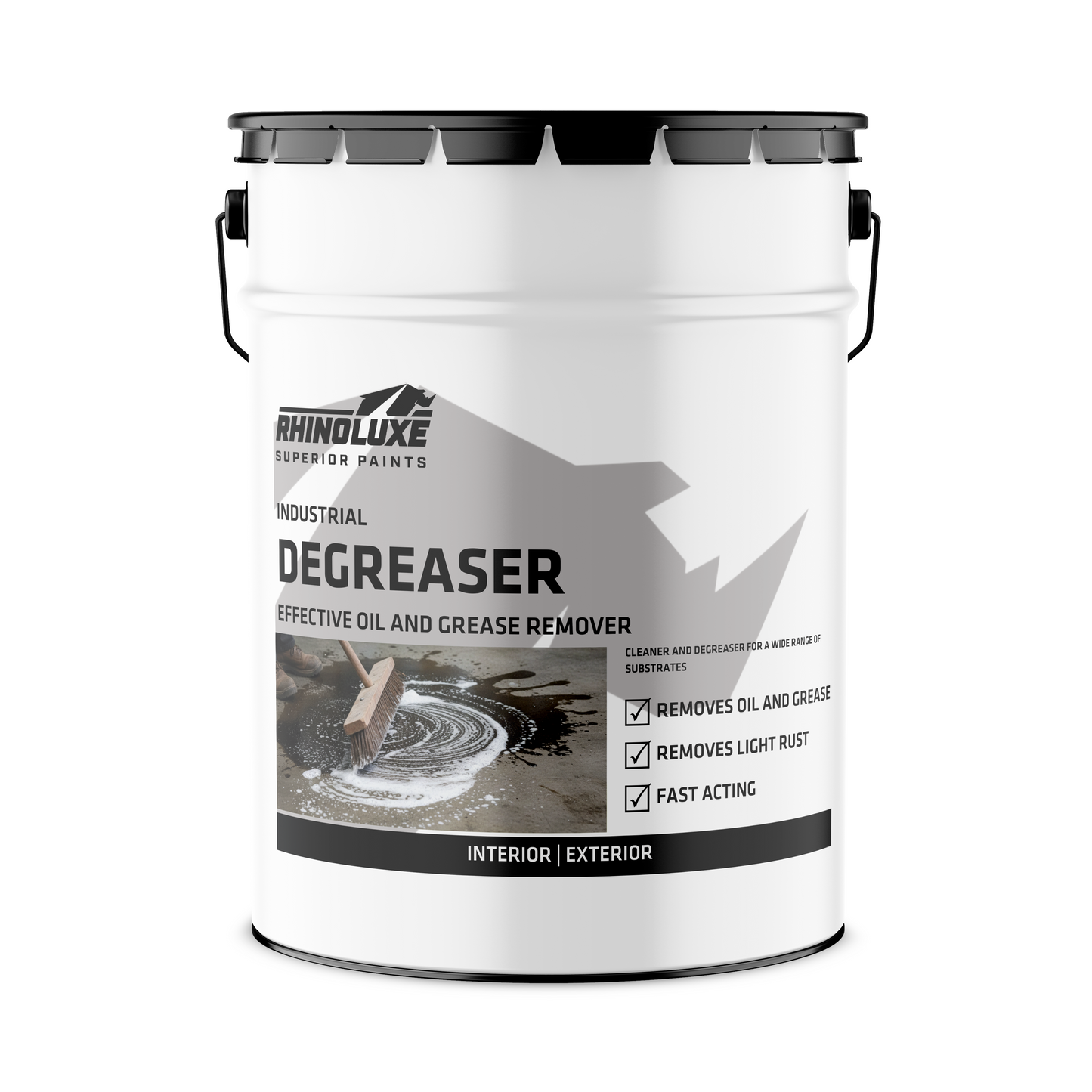
Oil and grease left on metal surfaces cause paint to peel, blister, and fail within months of application. Workshop floors stained with hydraulic fluid become hazardous and resist standard cleaning products. Galvanised roofing sheets arrive from the factory coated in protective oils that must be removed before any primer or topcoat will bond properly. Rhinoluxe Industrial Degreaser is a solvent-based surface preparation cleaner that dissolves petroleum grease, machine oil, and workshop contamination on mild steel, galvanised metal, and concrete. The hydrocarbon solvent blend cuts through stubborn oily residues that water-based cleaners leave behind, and rinses off with clean water to deliver a verified grease-free surface ready for the next coat.
Key Benefits
Solvent-Based Penetration for Petroleum Grease. The hydrocarbon solvent blend dissolves non-polar oils and greases at a molecular level, reaching contamination trapped in the pores and surface profile of steel and concrete that water-based alkaline cleaners cannot mobilise.
Water-Break-Free Surface Verification. Rinsing is complete when water sheets continuously across the surface without beading or pulling into droplets. This built-in quality check confirms the substrate is clean enough for primer application, removing the guesswork from surface preparation.
Dual-Use for Substrates and Application Equipment. The same product cleans greasy metal, oily concrete floors, and used brushes and rollers after painting. One SKU covers the preparation bay and the tool wash station, reducing inventory for contractors and maintenance teams.
Water-Washable Cleanup. Despite its solvent-based chemistry, the product rinses off with large volumes of clean water after scrubbing. This simplifies on-site cleanup without requiring additional solvents for disposal of the contaminated residue.
Direct Compatibility with the Rhinoluxe Coating System. Industrial Degreaser is the first step in the Rhinoluxe surface preparation sequence. Follow with Rust Remover where oxidation is present, then prime and topcoat with confidence that the adhesion foundation has been properly established.
Guides & How-Tos
Learn more in our advisory guides: the complete degreaser guide, the industrial degreaser guide, how to remove oil stains from concrete, and surface preparation before painting.
Technical Overview
Rhinoluxe Industrial Degreaser is a professional-grade, solvent-based cleaner and surface preparation product formulated with a hydrocarbon solvent blend containing xylene at less than 10%. The product is classified as a non-drying surface degreaser, meaning it does not cure or form a film on the substrate. It must be fully scrubbed in and rinsed off before any coating is applied.
The solvent system works on the principle that non-polar hydrocarbon solvents dissolve non-polar petroleum contamination. This gives the product a direct chemical advantage over water-based alkaline degreasers when dealing with machine oils, cutting fluids, mill oils on new galvanised steel, and baked-on workshop grease. The solvent penetrates the microscopic surface profile of the metal or concrete, dissolves the grease into solution, and the subsequent water rinse carries the emulsified contamination away from the surface.
Surface cleanliness is confirmed using the water-break-free test: after the final rinse, water poured over the surface must sheet uniformly with no beading. Any beading indicates residual hydrophobic contamination and the scrub-and-rinse cycle must be repeated. This aligns with ASTM F22 methodology for verifying the absence of hydrophobic surface films before coating, bonding, or conversion treatment.
Technical Specifications
| Property | Value |
|---|---|
| Product Type | Non-Drying Surface Degreaser |
| Chemical Base | Hydrocarbon Solvent Blend (Xylene <10%) |
| Appearance | Clear Thin Liquid |
| Flash Point | >21°C |
| Solubility | Hydrocarbon Solvents |
| Flammability | Flammable — R10 Classification |
| Application Method | Undiluted — Scrub with Hard Brush, Rinse with Water |
| Cleanliness Verification | Water-Break-Free Test (ASTM F22) |
| Cleanup | Clean Water |
| Packaging | 5 L and 20 L Metal Containers |
| Suitable Substrates | Mild Steel, Galvanised Steel, Concrete, Masonry |
Complementary Products
For optimal performance, use Rhinoluxe Industrial Degreaser as part of the complete surface preparation sequence:
- Rhinoluxe Rust Remover — Apply after degreasing to dissolve rust and passivate mild steel before priming.
- Rhinoluxe ZP4 Zinc Phosphate Primer — Anti-corrosive primer for degreased and passivated steel in harsh coastal environments.
- Rhinoluxe Red Oxide Primer — Standard anti-corrosive primer for prepared mild steel surfaces.
- Rhinoluxe MultiPrime — Multi-surface primer for galvanised steel, aluminium, and mixed substrates.
Technical Guidance
Apply the product undiluted to your contaminated surface and work it in thoroughly using a hard scrubbing brush or block brush. Do not use a paint brush — the bristles are too soft to generate the mechanical agitation you need to break the grease bond with the substrate. On heavily contaminated surfaces, give the solvent 2–5 minutes of contact time to penetrate baked-on deposits before you start scrubbing.
Rinse your surface with large volumes of clean water after scrubbing. Repeat the wash-and-rinse cycle until the metal passes the water-break-free test: pour clean water over the surface and check whether it sheets uniformly or breaks into beads. Beading means grease remains and you need to repeat the cycle. Skipping this verification step is the single most common cause of premature paint failure on degreased metal.
Allow your surface to dry completely before you apply any primer or topcoat. Coating over a damp substrate traps moisture beneath the paint film and leads to blistering, particularly on galvanised roofing in humid coastal areas like Durban and Cape Town. Bare steel in high-humidity environments is susceptible to flash rust within hours of cleaning, so plan your degreasing and priming schedule to avoid leaving bare metal exposed overnight.
Never apply the product to hot surfaces. Metal that has been sitting in direct sun can reach temperatures above 60°C, causing the solvent to evaporate before it has time to dissolve the grease. Work during cooler parts of the day and ensure the surface temperature is below 40°C for effective cleaning.
This product is flammable. Keep away from all sources of ignition including welding, grinding, open flames, and smoking. Use only in well-ventilated areas. Wear protective gloves and safety goggles at all times during application. Avoid breathing in the vapours. Refer to the Safety Data Sheet for full handling and storage precautions.
Couldn't load pickup availability
Questions & Answers
Have a Question?
-
Can I use Industrial Degreaser on painted surfaces?
No. The hydrocarbon solvent blend will soften, dissolve, or lift most existing paint systems. The product is designed for bare metal and uncoated concrete surfaces only. Where painted surfaces need degreasing before a maintenance recoat, use a mild water-based cleaner instead.
-
Why does the product come in metal containers rather than plastic?
Organic solvents can cause degradation and leaching in standard HDPE plastic containers over time, especially in high-temperature storage conditions common in South African warehouses. Metal containers maintain the chemical integrity of the solvent blend.
-
Do I need to use Rust Remover after degreasing?
Only where rust is present. The Industrial Degreaser removes oil and grease contamination. Rhinoluxe Rust Remover dissolves iron oxide and deposits a passivation layer. The correct sequence for rusted steel is: degrease first, then treat with Rust Remover, rinse, dry, and prime.
-
What happens if I paint over a surface that was not properly degreased?
Residual grease acts as a release layer between the metal and the coating system. The primer cannot form a mechanical or chemical bond with the substrate. The result is adhesion failure, blistering, and peeling within weeks to months of application.
-
Why is a solvent-based degreaser better than water-based for metal prep?
Petroleum grease and machine oil are non-polar contaminants. A hydrocarbon solvent system has stronger chemical affinity for these non-polar residues than water-based alkaline cleaners. The solvent dissolves the grease at a molecular level and penetrates into the surface profile of the metal.
-
Is Industrial Degreaser safe to use indoors?
Use this product in well-ventilated areas only. The solvent produces vapours that may cause irritation, dizziness, and nausea in enclosed spaces. Wear protective gloves and safety goggles. Do not use near open flames, welding, or grinding.
-
What sizes does Rhinoluxe Industrial Degreaser come in?
Rhinoluxe Industrial Degreaser is available in 5 litre and 20 litre metal containers. The 20 litre option provides the best value for large workshop, factory, and commercial surface preparation projects.
-
Can I clean paint brushes and rollers with this product?
Yes, dip the brushes or rollers into the product and work the degreaser into the bristles or pile. Rinse with clean water and repeat until clean. The product removes residual paint, oils, and grease from application equipment.
-
Is Rhinoluxe Industrial Degreaser water-based or solvent-based?
Rhinoluxe Industrial Degreaser is solvent-based with a hydrocarbon solvent blend. The solvent cuts through petroleum grease more effectively than water-based alkaline cleaners. Despite its solvent chemistry, the product rinses off with clean water after scrubbing.
-
Does Industrial Degreaser work on concrete floors?
Yes, the solvent-based formula dissolves petroleum oil and grease on concrete factory floors and masonry surfaces. Scrub with a stiff brush, rinse with water, and ensure the floor is completely dry before applying floor paint or sealer.
-
What does water-break free mean?
Water-break free means that clean water sheets uniformly across the surface without beading or pulling into droplets. Beading indicates residual grease. Repeat the scrub-and-rinse cycle until the water sheets continuously across the metal.
-
Can I use Industrial Degreaser on galvanised steel roofing?
Yes, Rhinoluxe Industrial Degreaser removes the factory oils and greases that manufacturers apply to protect galvanised steel during transit. Scrub the product into the surface, rinse thoroughly, and confirm a water-break-free result before priming.
-
How do I use Rhinoluxe Industrial Degreaser on steel?
Apply the product undiluted and work it into the surface with a hard scrubbing brush. Rinse with large volumes of clean water and repeat until the surface is water-break free. Allow the metal to dry completely before applying primer.